
Abstract
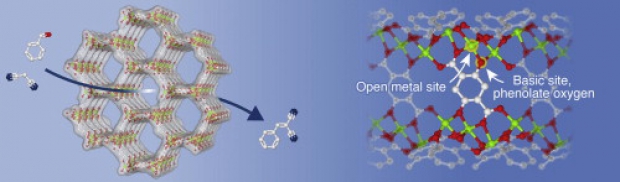
The hybrid frameworks M2dobdc (dobdc4− = 2,5-dioxidoterephthalate, M2+ = Mg2+, Co2+, Ni2+, Cu2+ and Zn2+), commonly known as CPO-27 or MOF-74, are shown to be active catalysts in base-catalyzed reactions such as Knoevenagel condensations or Michael additions. Rather than utilizing N-functionalized linkers as a source of basicity, the intrinsic basicity of these materials arises from the presence of the phenolate oxygen atoms coordinated to the metal ions. The overall activity is due to a complex interplay of the basic properties of these structural phenolates and the reactant binding characteristics of the coordinatively unsaturated sites. The nature of the active site and the order of activity between the different M2dobdc materials were rationalized via computational efforts; the most active material, both in theory and in experiment, is the Ni-containing variant. The basicity of Ni2dobdc was experimentally proven by chemisorption of pyrrole and observation by IR spectroscopy.
 Open Access version available at UGent repository