
Abstract
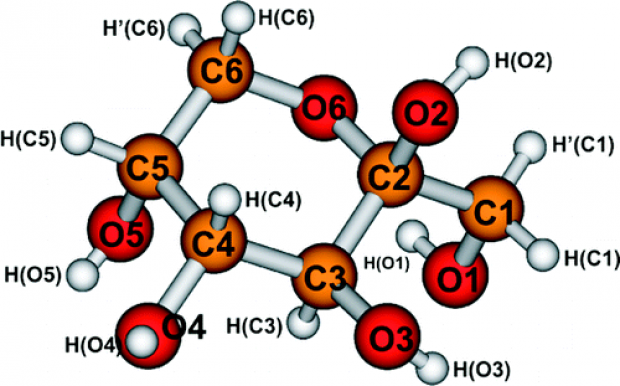
Stable free radical formation in fructose single crystals X-irradiated at room temperature was investigated using Q-band electron paramagnetic resonance (EPR), electron nuclear double resonance (ENDOR), and ENDOR induced EPR (EIE) techniques. ENDOR angular variations in the three main crystallographic planes allowed an unambiguous determination of 12 proton HFC tensors. From the EIE studies, these hyperfine interactions were assigned to six different radical species, labeled F1−F6. Two of the radicals (F1 and F2) were studied previously by Vanhaelewyn et al. [Vanhaelewyn, G. C. A. M.; Pauwels, E.; Callens, F. J.; Waroquier, M.; Sagstuen, E.; Matthys, P. J. Phys. Chem. A 2006, 110, 2147.] and Tarpan et al. [Tarpan, M. A.; Vrielinck, H.; De Cooman, H.; Callens, F. J. J. Phys. Chem. A 2009, 113, 7994.]. The other four radicals are reported here for the first time and periodic density functional theory (DFT) calculations were used to aid their structural identification. For the radical F3 a C3 carbon centered radical with a carbonyl group at the C4 position is proposed. The close similarity in HFC tensors suggests that F4 and F5 originate from the same type of radical stabilized in two slightly different conformations. For these radicals a C2 carbon centered radical model with a carbonyl group situated at the C3 position is proposed. A rather exotic C2 centered radical model is proposed for F6.
