
Abstract
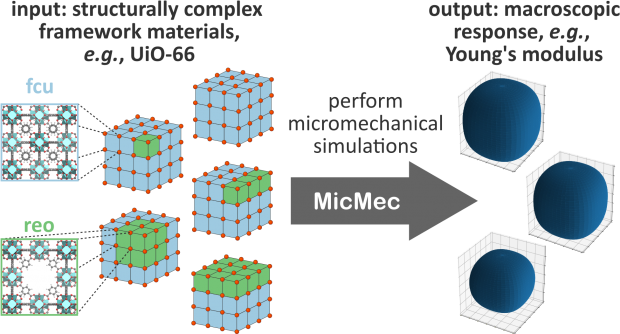
New functional materials, such as mixed matrix membranes and metal–organic framework (MOF) monoliths, outperform traditional materials in gas separation and storage applications, among other pressing challenges. However, while most engineered materials nowadays exhibit spatial heterogeneities on different length scales, available simulation techniques to date cannot capture this spatial complexity fully. Herein, we present the MicMec implementation of the micromechanical model we introduced earlier as a systematic coarse-graining approach to routinely access these larger length scales and characterize the mechanical properties of these materials. We thoroughly discuss the key components of our open-source code and validate it both on an analytical system and a case study on correlated reo defects in the UiO-66 MOF. We reveal that the time step that can be reached in micromechanical simulations is 2 to 3 orders of magnitude larger than for atomistic simulations, while still capturing well the macroscopic mechanical properties of the spatially disordered UiO-66 material. It is our hope that the MicMec implementation discussed here may provide a complementary tool to existing atomistic and coarse-grained software and aid the computational design of new materials for pressing applications.
