
T. Verstraelen
Primary tabs
Content
This is a debugging block
GBasis: A Python library for evaluating functions, functionals, and integrals expressed with Gaussian basis functions
The Journal of Chemical Physics
161(4), 042503
2024
A1
Abstract
GBasis is a free and open-source Python library for molecular property computations based on Gaussian basis functions in quantum chemistry. Specifically, GBasis allows one to evaluate functions expanded in Gaussian basis functions (including molecular orbitals, electron density, and reduced density matrices) and to compute functionals of Gaussian basis functions (overlap integrals, one-electron integrals, and two-electron integrals). Unique features of GBasis include supporting evaluation and analytical integration of arbitrary-order derivatives of the density (matrices), computation of a broad range of (screened) Coulomb interactions, and evaluation of overlap integrals of arbitrary numbers of Gaussians in arbitrarily high dimensions. For circumstances where the flexibility of GBasis is less important than high performance, a seamless Python interface to the Libcint C package is provided. GBasis is designed to be easy to use, maintain, and extend following many standards of sustainable software development, including code-quality assurance through continuous integration protocols, extensive testing, comprehensive documentation, up-to-date package management, and continuous delivery. This article marks the official release of the GBasis library, outlining its features, examples, and development.
Variational Hirshfeld Partitioning: General Framework and the Additive Variational Hirshfeld Partitioning Method
Journal of Chemical Theory and Computation
20(22), pp.9939--9953
2024
A1
STable AutoCorrelation Integral Estimator: Robust and Accurate Transport Properties from Molecular Dynamics Simulations
Journal of Chemical Information and Modeling (JCIM)
65(19), pp. 10445-10464
2025
A1
Abstract
STACIE (STable AutoCorrelation Integral Estimator) is a novel algorithm and Python package that delivers robust, uncertainty-aware estimates of autocorrelation integrals from time-correlated data. While its primary application is deriving transport properties from equilibrium molecular dynamics simulations, STACIE is equally applicable to time-correlated data in other scientific fields. A key feature of STACIE is its ability to provide robust and accurate estimates without requiring manual adjustment of hyperparameters. Additionally, one can follow a simple protocol to prepare sufficient simulation data to achieve a desired relative error of the transport property. We demonstrate its application by estimating the ionic electrical conductivity of a NaCl-water electrolyte solution. We also present a massive synthetic benchmark data set to rigorously validate STACIE, comprising 15,360 sets of time-correlated inputs generated with diverse covariance kernels with known autocorrelation integrals. STACIE is open source and available on GitHub and PyPI, with comprehensive documentation and examples.
 Open Access version available at UGent repository
Gold Open Access
The Tale of HORTON: Lessons Learned in a Decade of Scientific Software Development
Journal of Chemical Physics
Volume 160, Issue 16
2024
A1
Abstract
HORTON is a free and open-source electronic-structure package written primarily in Python 3 with some underlying C++ components. While HORTON’s development has been mainly directed by the research interests of its leading contributing groups, it is designed to be easily modified, extended, and used by other developers of quantum chemistry methods or post-processing techniques. Most importantly, HORTON adheres to modern principles of software development, including modularity, readability, flexibility, comprehensive documentation, automatic testing, version control, and quality-assurance protocols. This article explains how the principles and structure of HORTON have evolved since we started developing it more than a decade ago. We review the features and functionality of the latest HORTON release (version 2.3) and discuss how HORTON is evolving to support electronic structure theory research for the next decade. Keywords: quantum chemistry software, computational chemistry, Hartree-Fock method, model hamiltonians, Density Functional Theory (DFT) methods, numerical integration grids, periodic boundary conditions, Gaussian integrals, atoms-inmolecules partitioning schemes, Hirshfeld partitioning, population analysis, electrostatic potential fitting, parsing and converting computational chemistry file formats, theoretical chemistry Python library
Private attachment

Managing Expectations and Imbalanced Training Data in Reactive Force Field Development: An Application to Water Adsorption on Alumina
Journal of Chemical Theory and Computation (JCTC)
2024
A1
Abstract
ReaxFF is a computationally efficient model for reactive molecular dynamics simulations that has been applied to a wide variety of chemical systems. When ReaxFF parameters are not yet available for a chemistry of interest, they must be (re)optimized, for which one defines a set of training data that the new ReaxFF parameters should reproduce. ReaxFF training sets typically contain diverse properties with different units, some of which are more abundant (by orders of magnitude) than others. To find the best parameters, one conventionally minimizes a weighted sum of squared errors over all of the data in the training set. One of the challenges in such numerical optimizations is to assign weights so that the optimized parameters represent a good compromise among all the requirements defined in the training set. This work introduces a new loss function, called Balanced Loss, and a workflow that replaces weight assignment with a more manageable procedure. The training data are divided into categories with corresponding “tolerances”, i.e., acceptable root-mean-square errors for the categories, which define the expectations for the optimized ReaxFF parameters. Through the Log-Sum-Exp form of Balanced Loss, the parameter optimization is also a validation of one’s expectations, providing meaningful feedback that can be used to reconfigure the tolerances if needed. The new methodology is demonstrated with a nontrivial parametrization of ReaxFF for water adsorption on alumina. This results in a new force field that reproduces both the rare and frequent properties of a validation set not used for training. We also demonstrate the robustness of the new force field with a molecular dynamics simulation of water desorption from a γ-Al2O3 slab model.
This publication is licensed under the terms of your institutional subscription. Request reuse permissions.
Simple Molecular Model for Hydrate Silicate Ionic Liquids, a Realistic Zeolite Precursor
Chemistry of Materials
36, 8, 3886-3897
2024
A1
Abstract
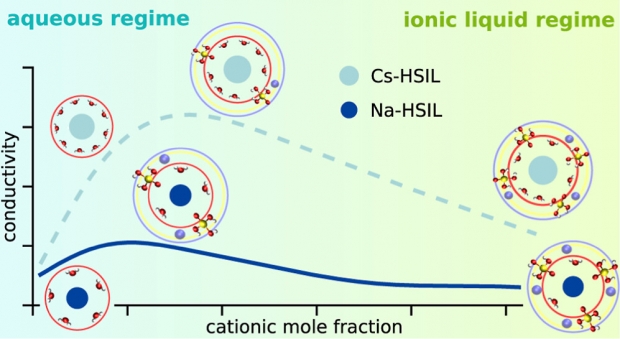
Despite the widespread use of zeolites in the chemical industry, their formation process is not fully understood due to the complex and heterogeneous structure of traditional synthesis media. Hydrated silicate ionic liquids (HSILs) have been proposed as an alternative. They are truly homogeneous and transparent mixtures with a low viscosity, facilitating experimental characterization. Interestingly, their homogeneous nature and simple speciation bring realistic molecular models of a zeolite growth liquid within reach for the first time. In this work, a simple molecular model is developed that gives insight into the crucial role of the alkali cations (sodium, potassium, rubidium, and cesium). Thereby, molecular dynamics simulations are combined with experimental measurements to demonstrate that the HSIL liquid structure strongly depends on the charge density and concentration of the alkali cation. As the water content increases, it transitions from a glassy network with fast ion exchange to an aqueous solution containing long-lasting solvated ion pairs. Furthermore, simulations reveal that the cation is capable of bringing several silicate monomers together in a glassy network, displaying perfect orientations for condensation reactions that underlie zeolite formation. This work is an important step toward the development of molecular models that can fully describe the early nucleation process of zeolites in combination with experiments.
Open Access version available at UGent repositoryPrivate attachment
The Gradient Curves Method: An improved strategy for the derivation of molecular mechanics valence force fields from ab initio data
LECTURE SERIES ON COMPUTER AND COMPUTATIONAL SCIENCES
Volume 7A-B, page 576 -+
2006
P1
Abstract
A novel force-field parameterization procedure[1] is proposed that surmounts well-known difficulties of the conventional least squares parameterization. The multidimensional ab initio training data are first transformed into individual one-dimensional data sets, each associated with one term in the force-field model. In the second step conventional methods call be used to fit each energy term separately to its corresponding data set. The first step call be completed without any knowledge of the analytical expressions for the energy terms. Moreover the transformed data sets dictate the form of these expressions, which makes the method very suitable for deriving valence force fields. During the transformation in the first step, continuity and least-norm criteria are imposed. The latter facilitate the intuitive physical interpretation of the energy terms that are fitted to the transformed data sets, a prerequisite for transferable force fields. Benchmark parameterizations have been performed oil three small molecules, showing that the new method results in physically intuitive energy terms, exactly when a conventional parameterization would suffer from parameter correlations, i.e. when the number of redundant internal coordinates in the force-field model increases.
The significance of fluctuating charges for molecular polarizability and dispersion coefficients
The Journal of Chemical Physics
Volume 159, Issue 9
2023
A1
Abstract
The inŕuence of ŕuctuating charges or charge ŕow on the dynamic linear response properties of isolated molecules from the TS42 database is evaluated, with particular emphasis on dipole polarizability and C6 dispersion coefficients. Two new descriptors are deőned to quantify the charge-ŕow contribution to response properties, making use of the recoupled dipole polarizability to separate isotropic and anisotropic components. Molecular polarizabilities are calculated using the “frequency-dependent atom-condensed Kohn-Sham density functional theory approximated to second orderž, i.e. the ACKS2ω model. With ACKS2ω, the charge-ŕow contribution can be constructed in two conceptually distinct ways, which appear to yield compatible results. The charge-ŕow contribution is signiőcantly affected by molecular geometry and the presence of polarizable bonds, in line with previous studies. We show that the charge-ŕow contribution qualitatively reproduces the polarizability anisotropy. The contribution to the anisotropic C6 coefficients is less pronounced, but cannot be neglected. The effect of ŕuctuating charges is only negligible for small molecules with at most one non-hydrogen atom. They become important and sometimes dominant for larger molecules or when highly polarizable bonds are present, such as conjugated, double or triple bonds. Charge ŕow contributions cannot be explained in terms of individual atomic properties, because they are affected by non-local features such as chemical bonding and geometry. Therefore, polarizable force őelds and dispersion models can beneőt from the explicit modeling of charge ŕow.
Private attachment
DFT-Quality Adsorption Simulations in Metal–Organic Frameworks Enabled by Machine Learning Potentials
Journal of Chemical Theory and Computation (JCTC)
19, 18, 6313-6325
2023
A1
Abstract
Nanoporous materials such as metal–organic frameworks (MOFs) have been extensively studied for their potential for adsorption and separation applications. In this respect, grand canonical Monte Carlo (GCMC) simulations have become a well-established tool for computational screenings of the adsorption properties of large sets of MOFs. However, their reliance on empirical force field potentials has limited the accuracy with which this tool can be applied to MOFs with challenging chemical environments such as open-metal sites. On the other hand, density-functional theory (DFT) is too computationally demanding to be routinely employed in GCMC simulations due to the excessive number of required function evaluations. Therefore, we propose in this paper a protocol for training machine learning potentials (MLPs) on a limited set of DFT intermolecular interaction energies (and forces) of CO2 in ZIF-8 and the open-metal site containing Mg-MOF-74, and use the MLPs to derive adsorption isotherms from first principles. We make use of the equivariant NequIP model which has demonstrated excellent data efficiency, and as such an error on the interaction energies below 0.2 kJ mol–1 per adsorbate in ZIF-8 was attained. Its use in GCMC simulations results in highly accurate adsorption isotherms and heats of adsorption. For Mg-MOF-74, a large dependence of the obtained results on the used dispersion correction was observed, where PBE-MBD performs the best. Lastly, to test the transferability of the MLP trained on ZIF-8, it was applied to ZIF-3, ZIF-4, and ZIF-6, which resulted in large deviations in the predicted adsorption isotherms and heats of adsorption. Only when explicitly training on data for all ZIFs, accurate adsorption properties were obtained. As the proposed methodology is widely applicable to guest adsorption in nanoporous materials, it opens up the possibility for training general-purpose MLPs to perform highly accurate investigations of guest adsorption.
Private attachment
Pages

Postscript First
This is a debugging block
Postscript Second
This is a debugging block
Postscript Third
This is a debugging block
Preface First
This is a debugging block
Preface Second
This is a debugging block
Preface Third
This is a debugging block